Research, design & making · 6 pages · Select “View at 100%” to read the finer details.
04
Trust has a tempo
A kinetic wall installation about distance, speed and the pause
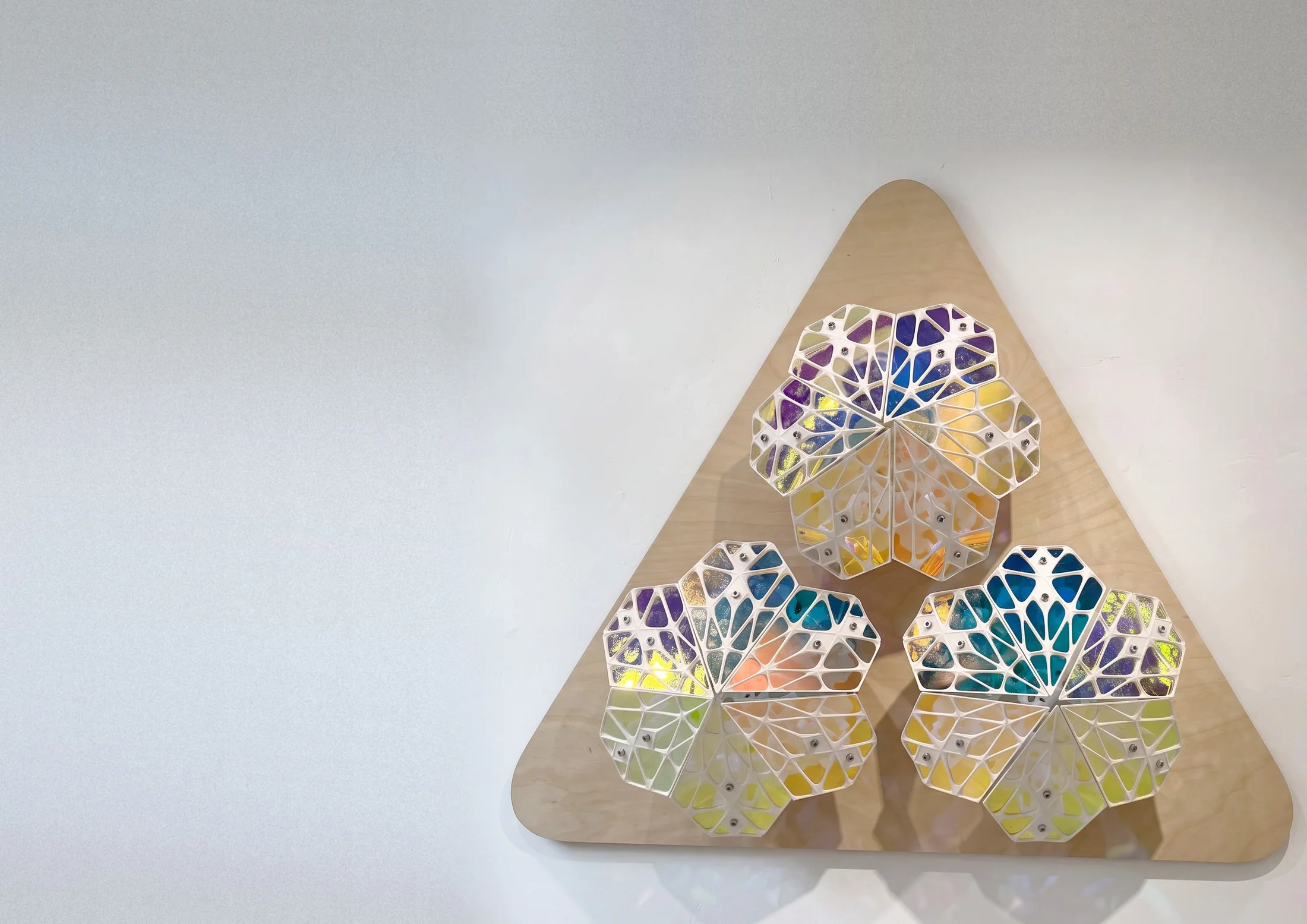
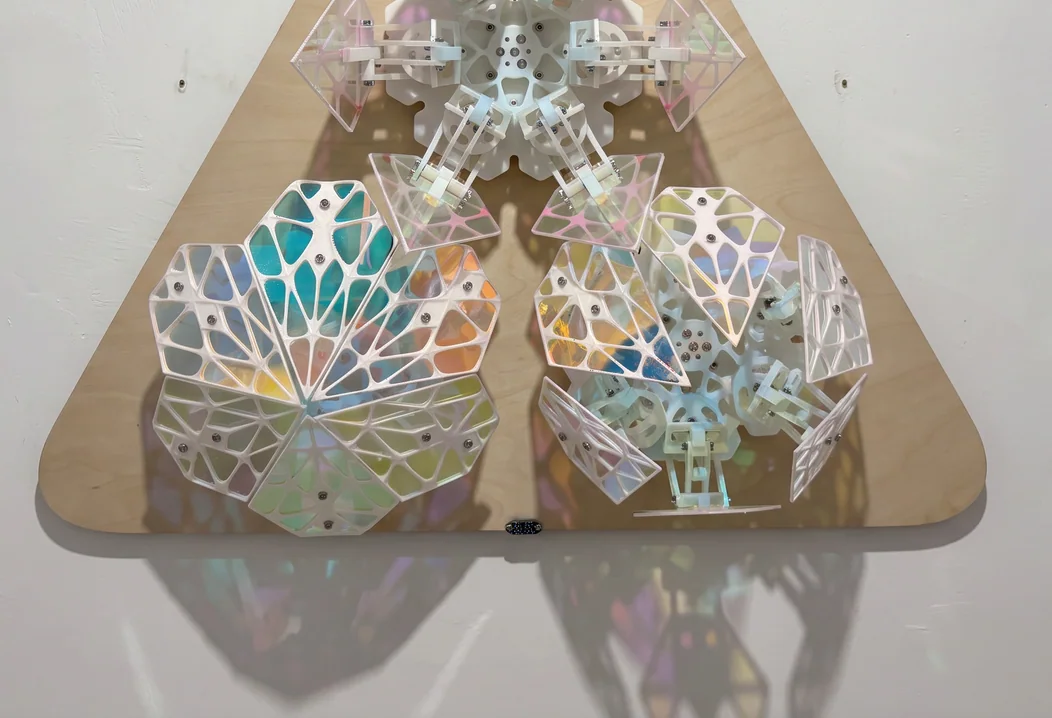
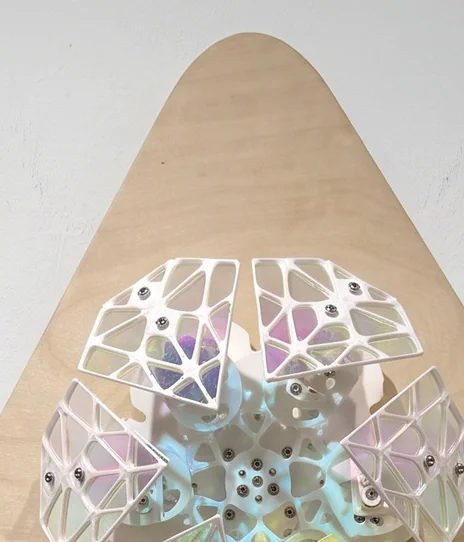
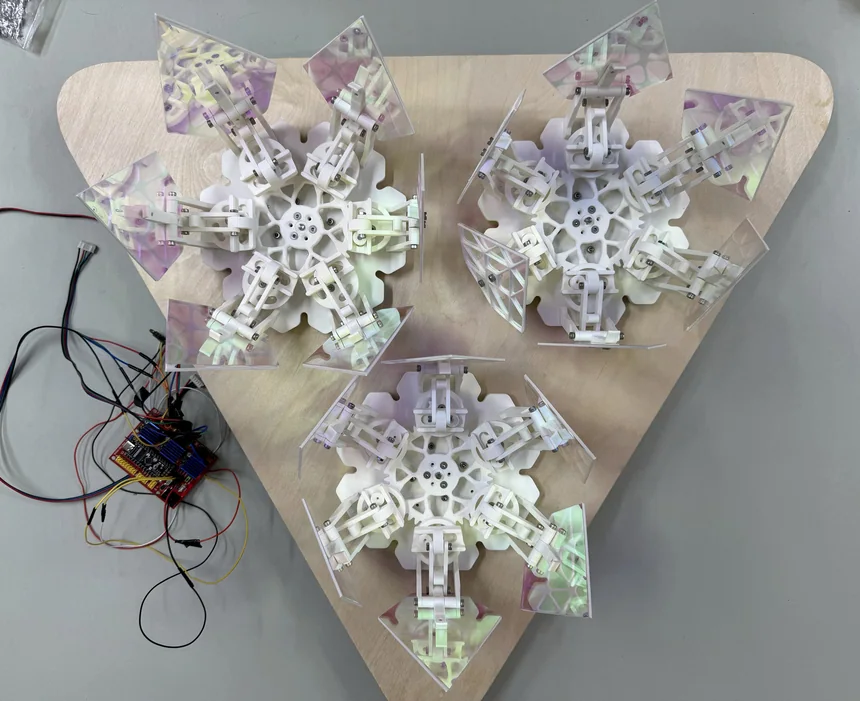
Three mechanical flowers on one board, watching how a visitor comes towards them.
Rush in and they close. Stop, and they wait with you. Come again, slowly, and they open.
Distance, speed and the pause in between are the only things it listens to. It is built from laser-cut plywood,
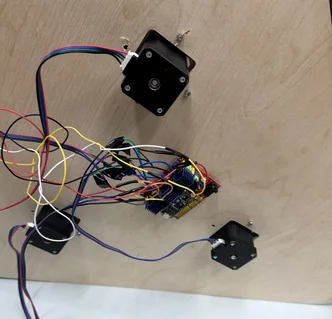
3D-printed mechanisms and petals and dichroic film, and runs on three stepper motors, one time-of-flight sensor and an Arduino.
01The piece
02Distance and speed
03One motor, six petals
04Four states
05Tuning and the record
06Making and validation
Trust Has a Tempo, 2026
Kinetic wall installation, interactive.
3flowers
18petals
192printed parts
1sensor
02 Interaction · how the piece reads an approach
Not how close. How you come close.
One time-of-flight sensor on the lower edge of the board measures the distance to whoever stands in front of it,
about thirty times a second. Distance only decides whether someone is in range. What the flowers do depends on
speed — the change in distance over time — and on how long a visitor stays still.
ASame distance, different tempotwo visitors, simulated with the v0 logic
BWhat one beam can seeside section, visitor 0.9 m away and reaching
A single beam returns one number: the distance to whatever crosses it first, whether that is a leg, a hand or a bag.
In the current build the sensor sits on the board's lower edge, so its height follows the hanging height.
That height is the first thing to settle on site. If the reach turns out to matter, a second sensor at chest height is the fallback
the concept already names.
1
VL53L0X time-of-flight sensoron the board's lower edge, aimed level into the room
CThe field, in plan
1Walking straight in stays inside the beam the whole way.
2Passing across at 1.45 m spends ~0.5 s in the beam (violet) — shorter than any timer, so it is ignored.
3Beside the beam: at 1 m the cone is only 44 cm wide, so half a step to the side is not there at all. Of two people in it, only the nearer counts.
DFrom range to speed
30 Hz → median of 3 → smoothing → Δd/Δt over 0.2 s → separate enter and exit thresholds, so a swaying visitor does not flicker the petals.
03 Structure · one flower, taken apart
One motor, six petals.
The concept gave every petal its own stepper motor: eighteen in all. The build gives each
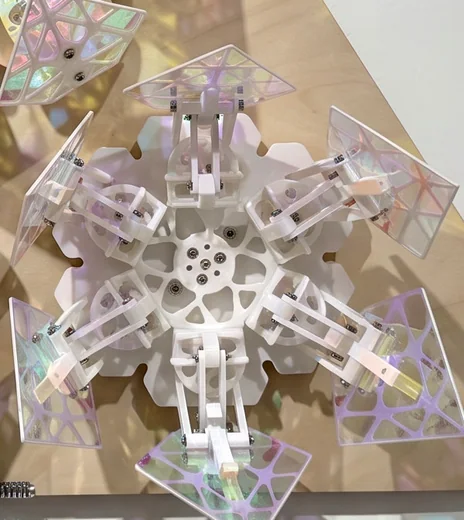
flower one. A NEMA 17 behind the board turns a 42-tooth sun gear, and the sun turns six 10-tooth pinions at once.
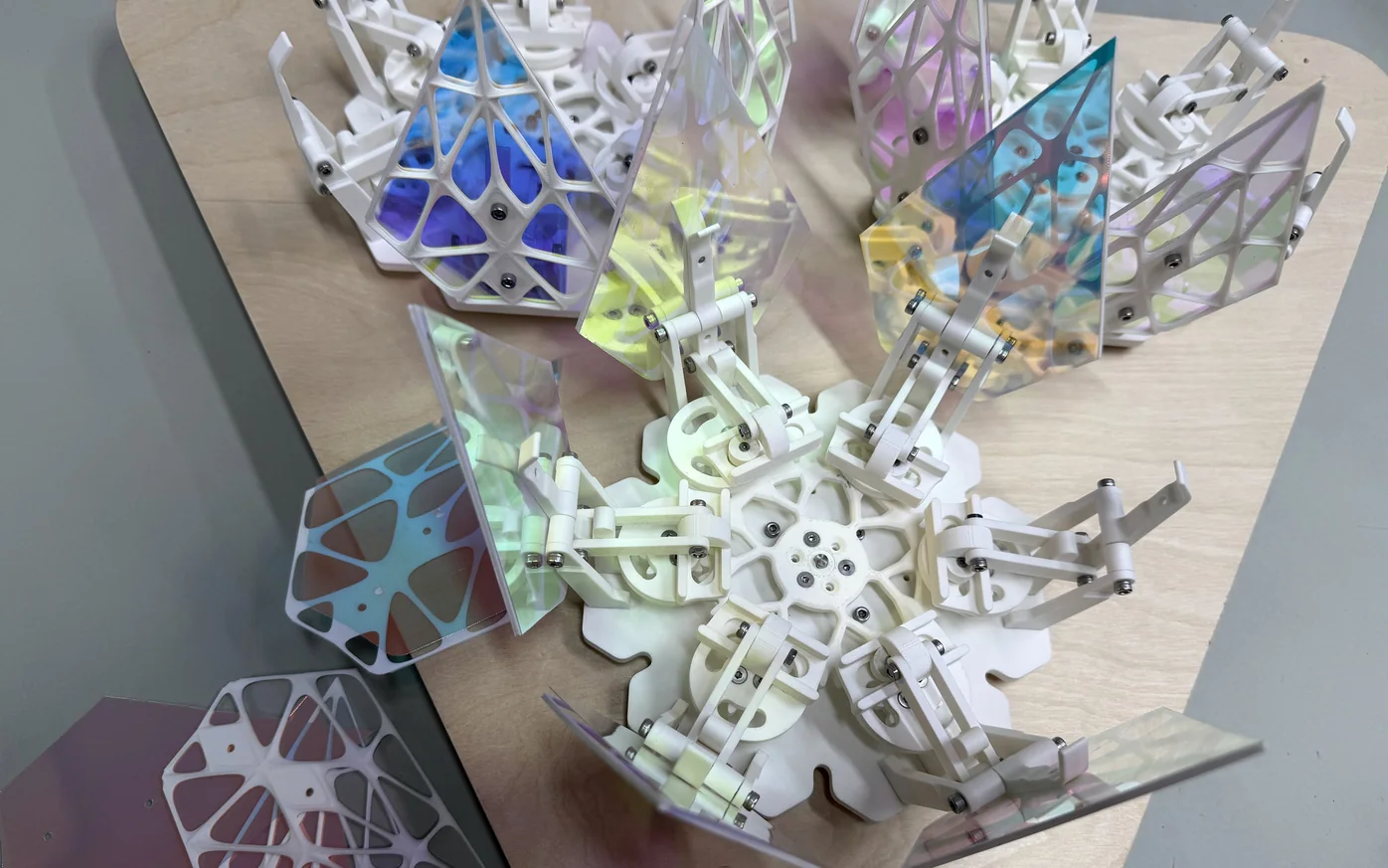
Each pinion carries a crank whose pin drives a slotted yoke and a pair of links, and the links swing the petal's arm.
Apart from screws and film, everything in front of the board is 3D-printed: 64 parts a flower.
AExploded flowerCAD, six layers
1
2
3
4
6
Sun gear, 42 Tthe motor hub sits under the four screws
Crank unitpinion under the disc, yoke on top
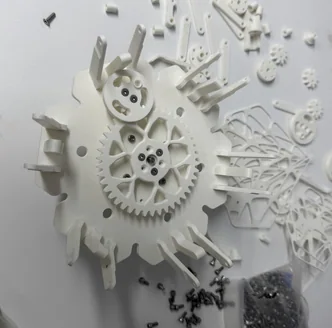
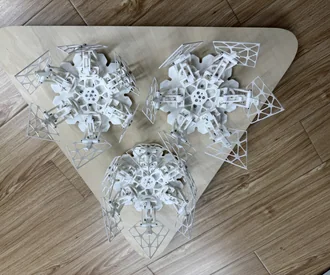
Fig. 3One flower on the bench, petals half fitted; the two behind it are complete.
Numbers match the exploded view.
BGear trainfront view
COne petal, one swing
D18 motors or 3
Concept
Build
Motors
18
3
Drivers
18
3, one shield
Motor wires
72
12
Zero points
18
3
Motor weight
≈ 5 kg
≈ 0.85 kg
Petals in a flower
free
locked in step
Stagger
petal by petal
flower by flower
One motor slips
one petal off
one flower lags
Weights at ~280 g per NEMA 17. Open-loop steppers each need a known zero after power-up.
Trade-offLost: a single petal hesitating on its own. Kept: the stagger, moved up from petals to flowers.
04 Behaviour · four answers
Four answers. No sudden moves.
Rush in and the petals close. Stop, and after a moment they part a crack. Come closer slowly
and they open, a little more for every second of patience. Lunge, and they pull back half way, then wait before trying again.
Each state only sets a target opening and a speed;
the motors ease towards it, so nothing on the wall ever jumps. Opening is never the prize: a visitor who only waits gets a glow,
and that is a complete answer too. When the room empties, the piece settles back to rest.
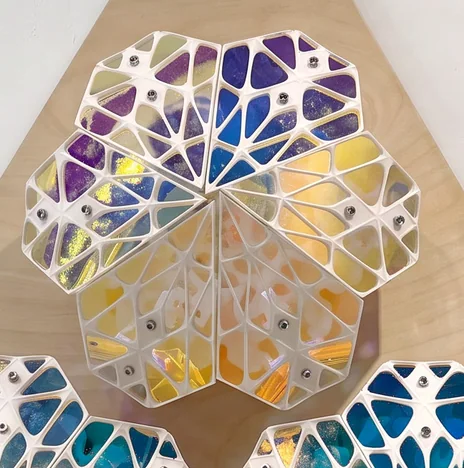
Closed0 % A dome of six petals: rest, close, and the start of every visit.
Opening≈ 40 % Petals tilt out together; the mechanism starts to show.
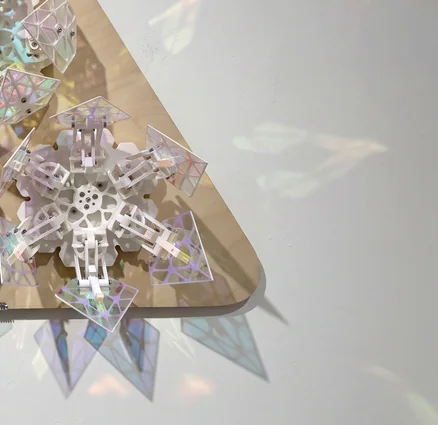
Open100 % Petals lie back flat; light and colour fall on the wall.
AStates and what moves between them
v0 logic, thresholds to be tuned on site · light values are planned: today the colour comes from the dichroic film
BOne visit, second by second
simulated with the v0 logic — the visitor's moves on top, the piece's answers below
Controller on the benchArduino Nano on a CNC shield: three stepper drivers, one per flower
05 Tuning · where the character comes from
Tuning is part of the work.
The same logic with different numbers meets the same visitor as three different characters.
Too sensitive, and the piece flinches at everyone; too dull, and nobody notices that they are the one moving it.
Several presets are kept side by side and compared on site, on the bench first.
AThree tempersthe numbers that change; everything else stays the same
Parameter
Wary
Measured · v0
Warm
What it changes
Counts as fast, enter / exit
0.60 / 0.40 m/s
0.80 / 0.50
1.10 / 0.70
how easily a rush closes it
Stillness before the glow
2.5 s
1.5 s
0.8 s
how long waiting takes to be noticed
Counts as slow
≤ 0.25 m/s, 0.9 s
≤ 0.35, 0.6 s
≤ 0.50, 0.4 s
what still counts as patient
Opening rate, approaching / still
7 / 2.5 %/s
12 / 4
16 / 6
how generous patience is
Glow opening
8 %
12 %
16 %
how wide the first crack is
Retreat depth / hold
80 pts / 4.0 s
50 / 2.5 s
30 / 1.5 s
how hard a lunge is felt
Recovery after a retreat
3 %/s
5 %/s
8 %/s
how quickly it forgives
BSame visitor, three temperssimulated; opening of flower 1 and state
CThe recordfour visits, aligned at the moment they enter range
DFour checks for the first sessionsproposed; read from the log
Question
Measure
Warning sign
Do they notice it answers?
change of pace within 3 s of the first response
fewer than 1 in 3 change pace too dull
Does it flinch?
closes and retreats per visit
more than 2 a visit too sensitive
Does patience pay?
first stop to half open
over 20 s too wary · under 5 s too warm
Does the tempo matter?
best opening, rushed visits against slow ones
less than 30 points apart too forgiving
What the log keeps visit D, a few lines
t s
d m
v m/s
state
open %
04.00
1.58
+0.19
open
10
09.00
0.79
+0.01
open
64
12.90
0.45
+0.96
retreat
73
13.30
0.44
-0.01
retreat
55
Time, distance, speed, state. No images, no sound, nothing that identifies anyone. A note on site says what is recorded and why.
The curves describe movement and the piece's replies. They do not measure trust.
1
2
3
4
5
6
7
8
9
10
11
12
06 Making and validation · built, then proven in steps
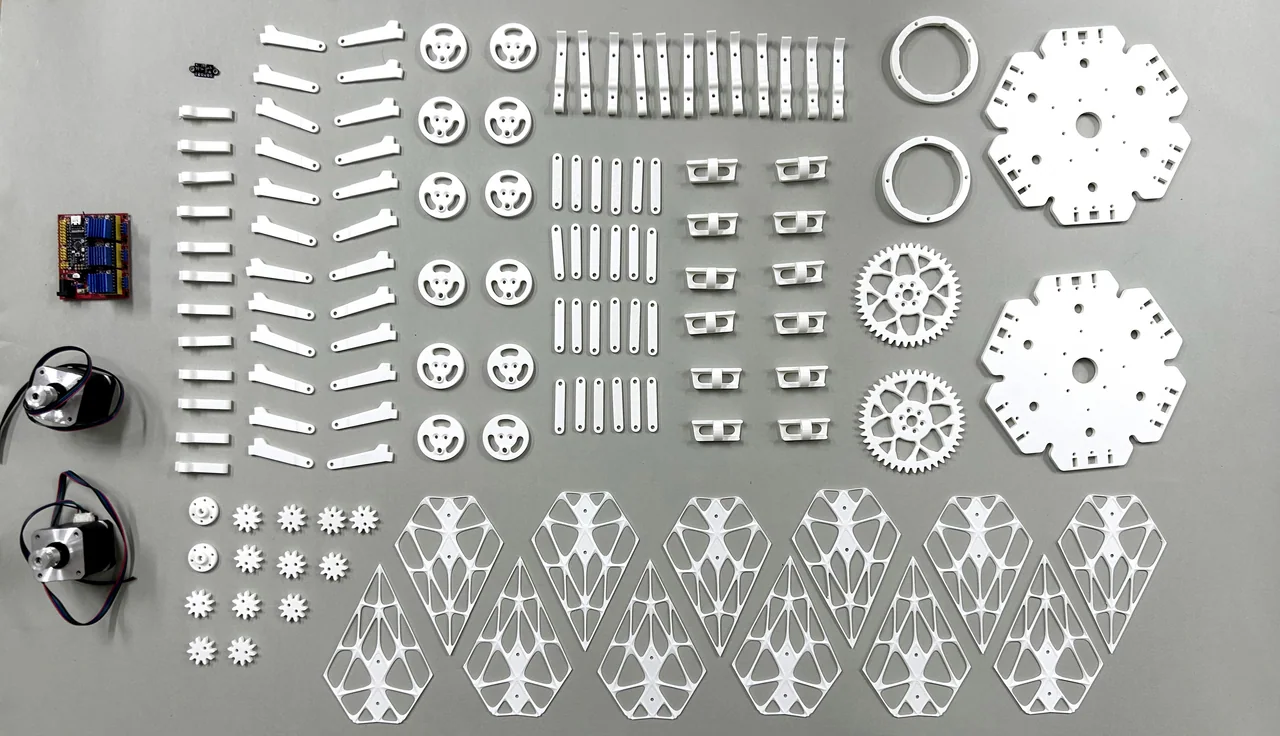
192 printed parts. One board.
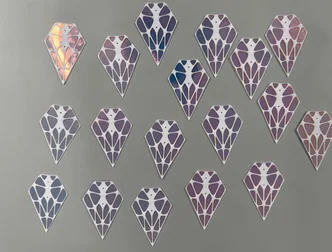
Printed parts for two flowers, laid out by type, with the controller, the sensor and two of the
three steppers on the far left. Each petal unit is ten parts; four more are shared by the flower. The film is cut by hand,
the board laser-cut, everything else printed and screwed.
Printed part
per petal
per flower
Not printed, per flower
1
Petal lattice
1
6
1 NEMA 17 stepper 6 dichroic film inserts machine screws and nuts
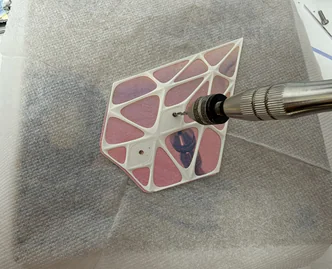
02 FitFilm set into the printed lattice and screwed down.
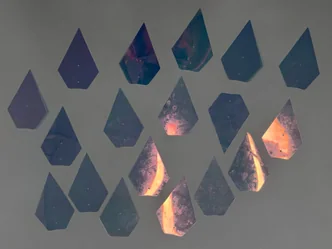
03 PetalsEighteen finished, sorted by colour.
04 GearsSun gear and the first crank on the base plate.
05 WiringThree steppers and the controller behind the board.
06 Dry fitThree bare mechanisms on the board, before the petals.
BProven in stepswhat the photos show, what is still to test
CKnown limits
01One beam reads the nearest thing, hand or body, in a cone 44 cm wide at 1 m. Settle the height on site; a second sensor if the reach matters.
02Pinch points. Closing speed is capped and travel limited in software; a gap that closes within reach must stay above 25 mm, the finger gap of ISO 13854. Check every petal pair.
03Lost steps. Open-loop steppers can lose steps unnoticed. Re-zero at every rest against a hard stop.
04Motor noise. Steppers whine at low speed; the concept keeps the mechanism's own sound. Listen in the room; quieter drivers if needed.
05Light. An inner glow is planned; today the dichroic film throws the colour. Decide with the room's own light.
Come closer, wait, try again, and the piece answers: slow down a little becomes something you can feel.